The Coffins of Nantucket
From Devon to the Island. 1609 to the 19th Century
Tristram Coffin is a direct maternal ancestor via the Coffin → Gardner → Macy → Folger → Perry descent. Tristram through his son James, granddaughter Hannah Coffin, and her son Robert Gardner carries the line into the Gardner → Macy → Folger → Perry descent, arriving at Harriet Ann Folger, the Perry generations, and Francis Swift Perry. Hannah Coffin’s father was confirmed as James (not his brother John) in the 2026-05-30 parentage resolution; see audit/00. Chain verified end-to-end via FamilySearch relationship view (data/tristram-chain-verify-s59.md).
Tristram
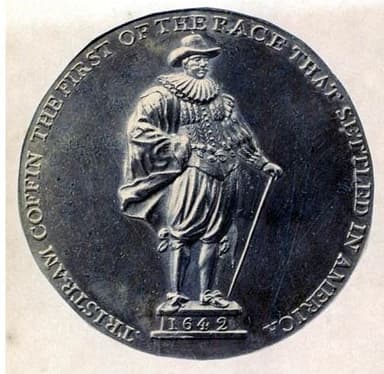
Tristram Coffin medallion
Tristram Coffin (1609-1681, PID: L8BH-G24) was baptized on March 11, 1609, at St. Mary’s Church in Brixton, Plymouth, Devon. He married Dionis Stevens (PID: MCCT-B3T) and emigrated to Massachusetts around 1642. The family moved through Salisbury, Haverhill, and Newbury before Tristram organized the purchase of Nantucket Island in 1659.
Tristram served as Chief Magistrate of Nantucket. He and Dionis had seven children, who together produced approximately seventy-five grandchildren, an extraordinary expansion that wove the Coffin name into virtually every family on the island within two generations.
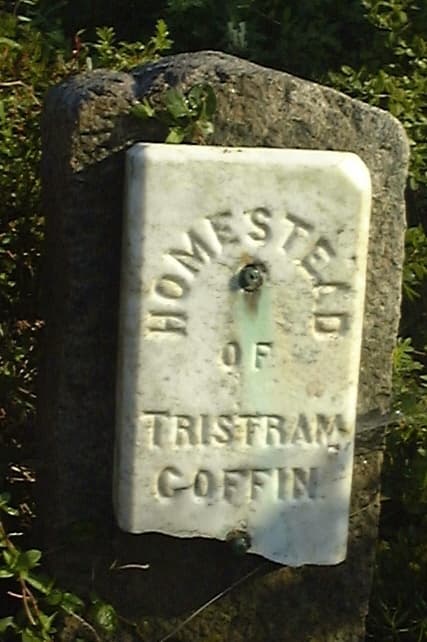
Why Tristram Left England
Tristram Coffin was a Royalist, loyal to King Charles I. He was not a Puritan. When the English Civil War broke out in 1642, the violence closed in on his Devon family: his brother Johnwas mortally wounded at Plymouth Fort and died eight days later (the records do not say which side he was fighting on). With the war at the family’s door, Tristram took his household to safety in Massachusetts in 1642, sailing on the Hector out of Plymouth with his wife Dionis, five children, his widowed mother Joan, and two unmarried sisters.
This flight was driven by the Civil War, not by Oliver Cromwell. In 1642 Cromwell was still only a captain of horse with no military record; he did not command an army until 1645, and was not Lord Protector until 1653, eleven years after Tristram had already left. The crossing led to the purchase of Nantucket in 1659 and the founding of the community that shapes this archive.
A separate upheaval of the same turbulent era reached the other side of the family. Twelve years after Tristram left, in 1654, the Cromwellian land settlement in Ireland (the Civil Survey) confiscated the lands of “John Long, alias the O’Long, Irish papist”in County Cork, reducing the family from landholders to tenants. The O’Longs were not driven across the Atlantic then: their descendants crossed in the famine of the 1850s, two centuries later. Four centuries after Tristram’s crossing, the descendants of both families, one leaving Devon in the Civil War, the other leaving Cork in the famine, would merge at the University of Massachusetts Amherst, where Carol Perry and John Patrick Long met as students in the 1970s. Full detail on the two departures: audit/07-17th-century-departures.md.
See the O’Long confiscation in Cork →
The 75 Grandchildren
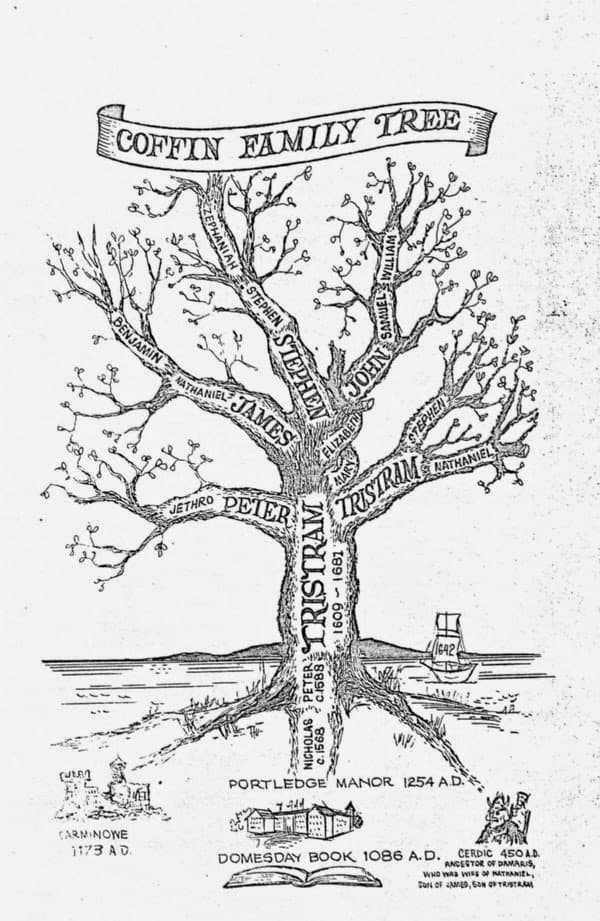
The Coffin family tree. Tristram and Dionis’s seven children and their marriages produced a web of interconnection across Nantucket.
Tristram and Dionis’s children married into every significant family on Nantucket. Their daughter Mary Coffin married Nathaniel Starbuck, becoming the island’s most influential citizen, the “Great Woman” who brought Quakerism to Nantucket. Son James Coffin carried the name into the whaling industry. The marriage of grandson Jethro Coffin to Mary Gardner in 1686 resolved the Coffin-Gardner feud that had split the island.
By the early 1700s, the seventy-five grandchildren had scattered the Coffin name across every corner of the island and beyond. The Barney Genealogical Record at the Nantucket Historical Association documents over 40,000 islanders, nearly all connected to this single family.
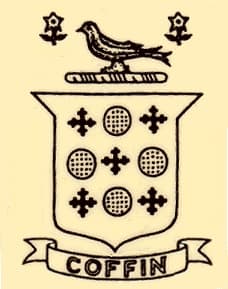
Coffin arms: Azure, a cross between four plates,
each charged with a cross crosslet
James Coffin: The Direct Line
The direct descent to John, Perry, and Patrick Long runs through James Coffin(1640), a son of Tristram and Dionis and a Nantucket magistrate. James’s daughter Hannah Coffin (1686, PID: M7FZ-T6T) married Benjiman Gardner; their son Robert Gardner (1708) carried the line forward through five generations of Nantucket-rooted Gardner, Macy, and Folger descendants to Harriet Ann Folger and the Perry chain. Hannah’s father was confirmed as James, not his brother John, in the 2026-05-30 parentage resolution: three sources (Find a Grave memorial for Richard Gardner Jr.; Coffinquest Rootsweb; Geni’s Mary Coffin profile), see audit/00. The downstream descent was verified end-to-end via the FamilySearch relationship view in S59 (see data/tristram-chain-verify-s59.md).
James was also the head of the collateral Revolution-era branch: his son Capt. Nathaniel Coffin (1671) fathered the line that split into Patriots and Loyalists a century later. That makes James the shared ancestor of both the direct line (through his daughter Hannah) and the Loyalist and reformer cousins. James’s younger brother John Coffin(1647), long assumed to be Hannah’s father, is a collateral ancestor under the corrected reading. See A House Divided: The Coffins in the Revolution for that story.
| Name | Born | PID | Relationship |
|---|---|---|---|
| ●James Coffin | 1640 | 9VWJ-WHJ | ~9th great-grandfather via the Coffin line. Tristram’s son; father of Hannah Coffin (parentage resolved 2026-05-30); Nantucket magistrate |
| ●John Coffin | 1647 | KNZ2-13G | collateral ancestor. Tristram’s son; James Coffin’s brother; the previously-assumed father of Hannah Coffin |
Nantucket Coffin generation, probed batch 4, April 2026
- Peter Coffin Sr.b. 1580. patriarch. Tristram’s father
- Peter Coffin Ib. 1630LY8Z-XW5
- Tristram Coffin Jr.b. 1631LZLZ-KSC
- Elizabeth Coffinb. 1634
- James Coffinb. 16409VWJ-WHJ. direct ancestor, father of Hannah Coffin; Nantucket magistrate
- John Coffinb. 1641
- Deborah Coffinb. 1642
- Mary Coffin (Starbuck)b. 1645
- John Coffinb. 1647KNZ2-13G. collateral (the previously-assumed father of Hannah Coffin)
- Stephen Coffinb. 1652
Notable Descendants
Benjamin Franklin (1706-1790, PID: LJLQ-WRC). Through Abiah Folger (PID: LH5P-98F), who married Josiah Franklin. Abiah was the daughter of Peter Folger (PID: 99BX-1P2), who was connected to the Coffin circle on Nantucket. Franklin is your 1st cousin, 10 times removed. Read the Folger-Franklin connection.
Sir Isaac Coffin (1759-1839). British Admiral who rose to the rank of Admiral in the Royal Navy, despite being born in Boston. Founded the Coffin School on Nantucket in 1827 for descendants of Tristram Coffin. A Loyalist who fought against the colonies yet returned to endow his ancestral island. Read about the Coffins in the Revolution.
Lucretia Coffin Mott (1793-1880, PID: LRBB-TZH). Born on Nantucket. Abolitionist, women’s rights pioneer, co-organizer of the Seneca Falls Convention. Descended from the Coffin and Folger lines. Read her full story.
Tuckernuck & Salvage
Research in progress. The Tuckernuck period and salvage controversies are being documented from oral history recordings. Details forthcoming.
From Nantucket to the Mainland
As whaling declined and the Great Fire of 1846 devastated the island, Coffin descendants scattered to the mainland. They settled in New Bedford, Fall River, and across Cape Cod, the same coastal towns where the Winter and Swift families were building their lives. The Winter-Swift connection, documented elsewhere in this archive, traces the path from Nantucket’s founding families to the New Bedford marriages that produced the current generation.
Sources
- Starbuck, Alexander. The History of Nantucket: County, Island, and Town. Boston: C. E. Goodspeed, 1924.
- Hinchman, Lydia S. Early Settlers of Nantucket: Their Associates and Descendants. 2nd ed. Philadelphia: Friends’ Book Association, 1901.
- Coffin, Louis. The Coffin Family: The Life of Tristram Coffyn of Nantucket and His Descendants. Nantucket Historical Association.
- Williams, Alicia Crane. “The Coffin Cluster.” Vita Brevis, American Ancestors (New England Historic Genealogical Society), November 15, 2019. vitabrevis.americanancestors.org.
- Tyler, Betsy. “Tristram Coffin Homestead Site Marker.” Nantucket Historical Association Properties Guide, 2015. The 1879 granite-and-marble monument near Capaum Pond, funded by Owen Tristram Coffin and Charles G. Coffin to mark the homestead of Tristram Coffin (1609-81), progenitor of the American Coffin family, has been maintained by the NHA since 1981. nha.org.
- Anderson, Robert Charles. The Great Migration Begins: Immigrants to New England 1620-1633. Vol. 1. Boston: NEHGS, 1995 (entry for Tristram Coffin).