Sir Richard Coffin
fl. 1066, by tradition · Coffin line · Traditional, Disputed: a Hastings origin the records do not support
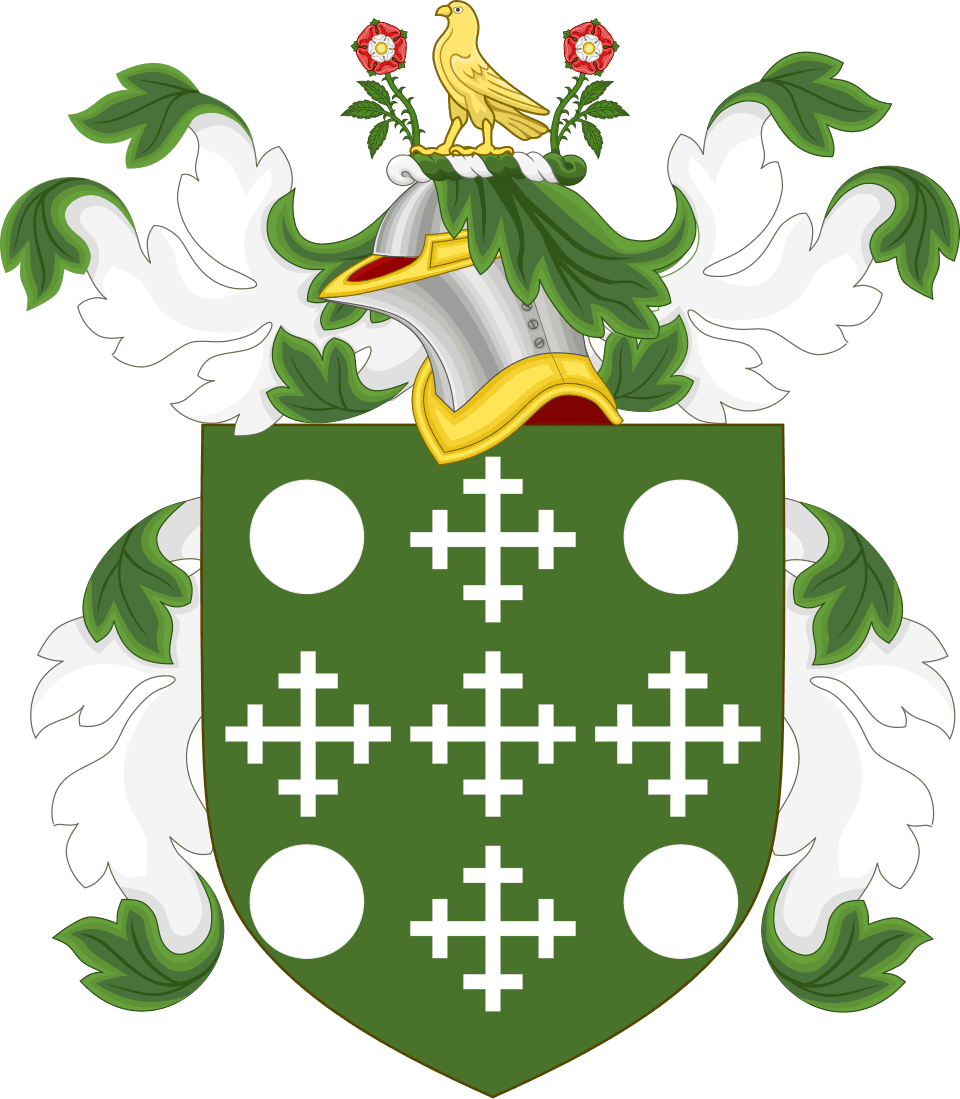
By family tradition a companion of William the Conqueror at Hastings, granted the Manor of Alwington in Devon. The 2026 audit could not document this: the Domesday Book of 1086 records Alwington under Hamelin, not a Coffin, and the standard Devon pedigree (Vivian's Visitations of Devon) reaches back only to a Richard Coffin under Henry II (1154-1189). The documented Coffin line begins in medieval Devon; the Norman-knight origin is preserved as labeled family tradition in the basement.
The Coffin Norman knight claim→Tristram Coffin
1609-1681 · Our 10th great-grandfather · founder of Nantucket
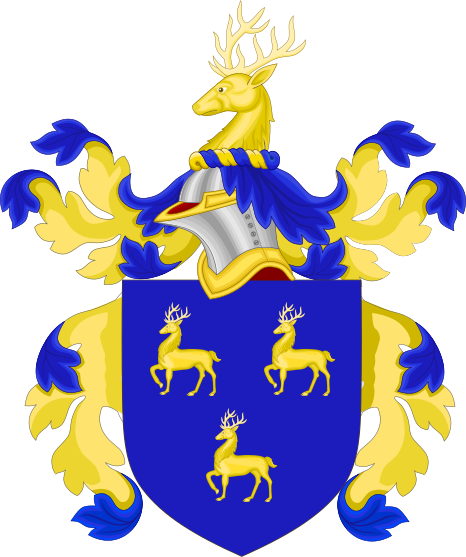
Organized the 1659 purchase of Nantucket Island for thirty pounds sterling and two beaver hats, and drafted the share-and-proprietor governance that structured the settlement. First Chief Magistrate of Nantucket (1660-1681). His descent to the brothers runs through his son James Coffin (9VWJ-WHJ) and James's daughter Hannah Coffin (parentage resolved 2026-05-30) into the Gardner, Macy, and Folger Nantucket marriages.
Ancestor Spotlight: Tristram Coffin→Mary Coffin Starbuck
1645-1717 · Our 9th great-grand-aunt (sister of James Coffin) · the “Great Woman” of Nantucket
Tristram Coffin’s daughter and the sister of James Coffin (1640-1720, 9VWJ-WHJ), the brothers’ direct maternal ancestor, so a great-aunt of the line, not a cousin. Contemporaries called her the “Great Woman” of Nantucket for her authority over island governance and trade; her 1702 conversion following John Richardson’s visit made her the mother of Nantucket Quakerism, shaping the island’s religious and civic life for a century.
Tristram Coffin and the Founding of Nantucket→Peter Folger
1617-1690 · Our 10th great-grandfather · Nantucket founder, Wampanoag interpreter
Surveyor and schoolmaster who surveyed Nantucket between 1659 and 1662 and served as interpreter to the Wampanoag. Author of “A Looking Glass for the Times,” a 1676 verse petition on behalf of persecuted Quakers and Baptists. His daughter Abiah Folger was the mother of Benjamin Franklin; his son John Folger carries the direct line into the brothers’ maternal descent.
The Folger Line: Peter Folger→Abiah Folger
1667-1752 · Our 9th great-grand-aunt (sister of John Folger) · mother of Benjamin Franklin
Peter Folger’s daughter and the sister of John Folger (1659-1732), the brothers’ direct maternal ancestor, a great-aunt of the line. Her son was Benjamin Franklin, who appears on this page as a first cousin ten times removed. The two branches meet in the Folger grandparents: the direct line runs through John, the Franklin line through Abiah.
Cousin: Benjamin Franklin (via Abiah Folger)→Benjamin Franklin
1706-1790 · Our 1st cousin, 10× removed, via Peter Folger
Franklin’s mother Abiah Folger was born on Nantucket in 1667. Her brother John Folger is the brothers’ direct ancestor; Abiah is Franklin’s mother. The descent is first-cousin at the grandchild level, ten generations removed, verified through the Peter Folger (99BX-1P2) common ancestor.
Cousin: Benjamin Franklin→Kezia “Miriam” Folger Coffin
1723-1798 · Our 1st cousin, 9× removed, via John Folger · Nantucket merchant
One of colonial Nantucket’s most successful merchants, a woman who ran a trading house in her own name. Our 1st cousin, 9 times removed, via John Folger (the father of our direct ancestor Jethro Folger); her mother, Abigail Folger, was Jethro’s sister. She sided with the British during the Revolution, her Loyalism named honestly, not led with.
Cousin: Kezia Folger Coffin→Herodias Long
c.1623-1686 · Our 10th great-grandmother · Quaker dissenter, Rhode Island
Publicly whipped in Weymouth and Boston in the 1650s for preaching Quaker doctrine, an incident documented in contemporary Puritan court records. Among the earliest recorded women to dissent from Massachusetts Bay religious authority; an early member of the Rhode Island community that sheltered similar dissenters.
The Women: Herodias Long→Stukely Westcott
1592-1677 · Our 10th great-grandfather · founder of Providence (1638 banishment, one of the thirteen original Proprietors)
One of the thirteen original proprietors of Providence and a co-founder of Warwick on the 1642-43 Shawomet purchase. Banished from the Massachusetts Bay Colony for religious dissent on 12 March 1638, three years after his Salem neighbor Roger Williams. His English origins before Salem are not established by primary documentation.
The Stukely Westcott Line→Rev. John Robinson
1576-1625 · Our 11th great-grandfather · Pilgrim pastor of Leiden
Theological founder of the Pilgrim movement, pastor of the Leiden congregation that became the Mayflower Pilgrims. He died in Leiden in 1625 without ever crossing the Atlantic, but his son Isaac emigrated to Plymouth and Cape Cod, and the line runs into the Swift dynasty and down to the brothers. Without Robinson there is no Pilgrim church and no Mayflower.
Ancestor Spotlight: Rev. John Robinson→Eunice Gardner
1744-1809 · Our 6th great-grandmother · the Coffin-Folger convergence
The single ancestor where the Coffin line (through her father Robert Gardner, whose mother was Hannah Coffin, Tristram’s granddaughter) and the Folger line (through her mother Jedidah Folger, Peter Folger’s great-granddaughter) converge. Her daughter Margaret “Peggy” Macy carries both lines forward into the Folger surname at Frederick William Folger in 1805.
The convergence in context→Rep. John J. Long
1927-1989 · Our paternal grandfather · MA House of Representatives, 1956-1980
Eleventh Bristol District. Assistant Majority Leader. Instrumental in the founding of Bristol Community College and the formation of what became UMass Dartmouth. Personal correspondent of John F. Kennedy, Edward Kennedy, and Michael Dukakis. Paternal grandfather to the brothers.
The Long Family→The Irish immigrant generation
1850s-1890s · Our paternal 2nd-3rd great-grandparents · Long, Coogan, Sullivan, Manion
Four Irish surname lines arrived in Fall River and surrounding New Bedford between the Famine emigration and the 1890s, establishing the parishes, trades, and extended family networks that the twentieth-century Longs grew into. The Coogan line reaches back to the ancient kingdom of Uí Maine in Connacht; the Manions and Sullivans came from Connacht and Munster respectively.
The Coogan Line→